Argentina faces an exhausting test in a World Cup that compresses everything
Five matches in 72 hours, reduced playing fields and an unprecedented tournament format will put the Argentinian team to the test in Baku. The challenge is not only sporting: it also requires managing the physical and logistical demands of a World Cup debut.
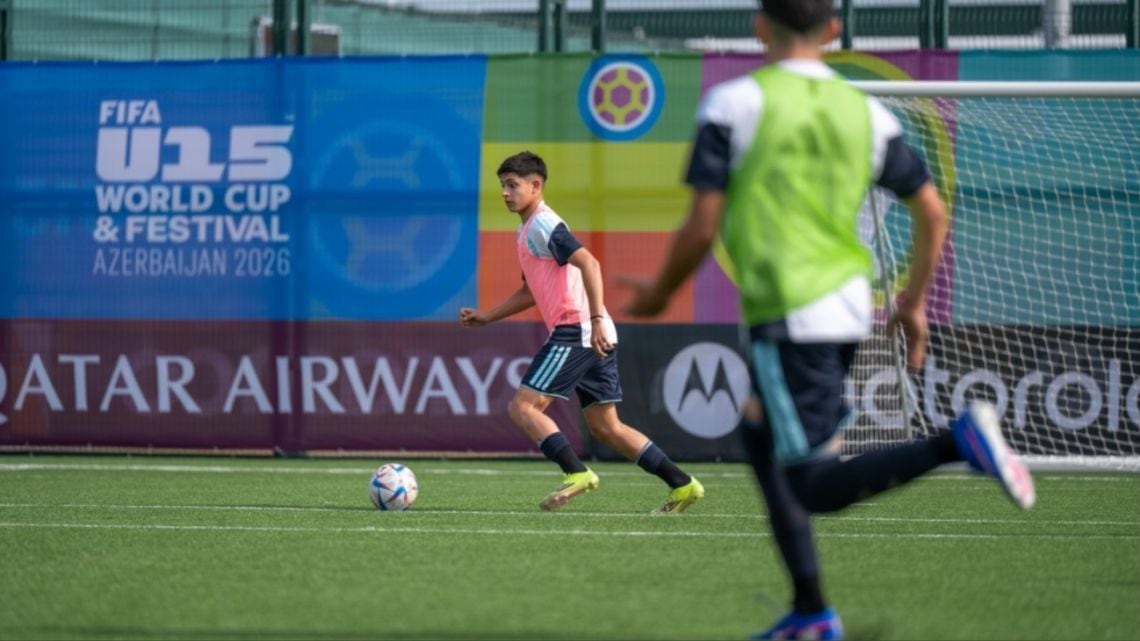
There is no time to catch your breath. That is the clearest message from Argentina's schedule at the first FIFA Under-15 World Cup and Festival: five matches in 72 hours. The tournament begins this Saturday in Baku, with the Argentine team, coached by Adrián Gallará, opening against Algeria at 2 a.m. Argentine time.
A marathon disguised as a group stage
Argentina will face Chinese Taipei on Sunday at 5:45 a.m. and Oman at 12:30 p.m. On Monday, the schedule includes Suriname at 4:30 a.m. and Malawi at 11:15 a.m. There is barely any room to prepare between games, recover physically or deal with the stress of traveling and competing at such an unusual pace.
The format does not resemble professional football. Each team will have eight players, including the goalkeeper, and will play two 20-minute halves. The fields measure 68 by 47 metres and there are no eliminations during the group stage. All teams advance, although to different levels. The winners of each group will reach Level A, which will determine the first world champion in this category.
- 189 federations will participate in the tournament.
- The teams will be divided into 32 groups, from Group A to Group AF.
- Each team will play once against every opponent in its group.
- The winners of each group will advance to Level A.
- All other teams will compete in Levels B, C, D, E and F.
- The tournament will feature nearly 950 matches over six days.
That last number is the most striking. Nearly 950 matches in six days, with each national team allowed a maximum of two games per day, means the competition demands enormous logistical coordination. It also changes the perspective: the tournament is not only about winning a football match, but about surviving an extremely compressed calendar.
Gallará knows the challenge. The Córdoba-born coach has been with the Argentine Football Association's youth divisions since 2017. The national delegation arrived in Baku with 14 players, all born in 2011 or 2012. The squad is young, but the agenda leaves little room for error. Or for comfort.
The question is whether this format benefits teams with more experience or gives emerging selections a chance. My view, for what it is worth, is that the advantage belongs to those who can recover quickly and organize themselves without wasting energy. A team that is technically prepared but physically overwhelmed could lose points before it has time to understand the field.
That is why Argentina's performance will depend on more than individual talent. The players will need to rotate minutes, manage fatigue and keep their concentration despite matches at unusual hours. In this format, a coach cannot only think about the next game. He must think about the fifth one, too.
I expect the aurinegro to be tested in the first match against Algeria. If they win, they will still have to face Chinese Taipei, Oman, Suriname and Malawi in rapid succession. The railway will be under pressure from the kickoff. We will see whether the team can make a strong start without paying the bill later. And, if my prediction fails, I will simply blame the strange schedule. It is always easier than explaining a defeat.
Te puede interesar